
· Charlie Holland · Architecture · 9 min read
The Angels' Share of Every Productivity Gain
Every year, roughly 2% of the whisky in every cask in Scotland breathes out through the wood and is gone. Nobody fights it. The angels' share, they call it, the price of letting the stuff mature at all. The economy runs the same trick on productivity, except our angels get greedier every year. Which is why Keynes promised your grandparents a fifteen-hour week and you're reading this between two meetings about a third.

Walk into a bonded warehouse on a still day and it’s the smell that gets you first. Damp stone, old oak, and underneath it something sweet and sharp that coats the back of your throat. That smell is money. It’s whisky, thousands of casks of it, breathing out through the wood into the dark.
They call it the angels’ share. Every year a cask matures, roughly 2% of what’s inside it evaporates through the staves and is gone. Over a twelve-year maturation that’s a quarter of the barrel, breathed off into the warehouse air and up through the roof. Nobody argues about it. There’s no engineer working on a fix, no supplier promising a tighter cask. It isn’t a leak. It’s the unavoidable price of letting the thing become what it’s meant to become. The whisky that’s left is real, and it’s good, and a share of it was simply never going to reach the glass.
I’ve come to think that’s the most honest picture we have of the modern economy. We just don’t have a word for our version of it.
We were promised the opposite of this
This should bother you more than it does.
In 1930, in the teeth of the Depression, John Maynard Keynes sat down and told his grandchildren’s generation what was coming. Not ruin. Abundance. He worked it through and concluded that by roughly now, give or take, the economic problem would be solved. Machines would do the work, output would multiply many times over, and the pressing question of the age would be what on earth to do with all the leisure. He landed on a fifteen-hour working week and worried, seriously, that we’d be bored.
He wasn’t a crank on the fringe. He was the most influential economist of the century, and the mid-century futurists who came after him agreed. The 1950s and 60s were thick with it: the four-day week, the home run by machines, the problem of abundance. Tomorrow’s World, basically. It was the consensus forecast.
And on the raw inputs, they were right. We built more computing power than any of them could have pictured. A phone in your pocket outruns the machine that ran the moon landings by a margin that stops being funny and starts being absurd. The output multiplied exactly as promised.
The leisure didn’t come. We got busier. Ask anyone. So where did it go?
The angels took it.
The paradox nobody can explain away
I’m not the first to notice the gap. Economists have a name for it, and they’ve been arguing about it since before I started work.
In 1987 Robert Solow, who had a Nobel for his trouble, put it in one line that’s been quoted ever since: you can see the computer age everywhere but in the productivity statistics. That’s the productivity paradox. The kit kept getting exponentially cheaper and more powerful, decade on decade, Moore’s law doing its thing without a pause. And measured productivity growth, the actual output per hour worked across the whole economy, slowed down after the 1970s and never really recovered. Robert Gordon spent seven hundred pages on it: the genuinely transformative gains, the ones that gave people their evenings back, mostly landed before 1970. Indoor plumbing, the electric grid, the motor car. The computer, for all of it, doesn’t show up in the numbers the way the washing machine did.
That’s a properly strange result. We poured half a century of exponential improvement into the economy and the economy shrugged. Every explanation people reach for, we mismeasure the gains, the good stuff is free and doesn’t count, the effect is just late, has been argued for decades and none of it closes the gap on its own.
I think the reason it stays a paradox is that everyone keeps counting what goes into the cask. Nobody counts the cost of maturity itself.
Where it goes
I wrote the last post about where it goes inside a single business. I won’t run it all again here, but the shape of it matters, so: complexity is never removed, only relocated, and in a modern company it relocates into the org chart. The standup with twenty-five people in it, arguing about a change that’s one line of code, is the bill. It’s the most expensive thing in the building and it appears on no diagram, because it’s booked as headcount, not as a line item called “complexity.”
Now stand back and do the same trick to the whole economy.
Every business got radically more capable over those fifty years. And almost none of them cashed the capability in as less work. They spent it on more. More products, more markets, more optionality, more systems, each one perfectly sensible on its own and each one adding something new that has to be coordinated with everything else. Complexity has to be held together by people, and people have to be organised, and past a certain size the organising becomes the main event. The company stops being a machine for making a thing and becomes an operating system whose largest running process is itself. The meetings, the alignment, the governance, the reorg, the programme to fix the last programme. David Graeber got a bestseller out of naming the human end of it, jobs the people doing them privately suspect are pointless, and whatever you make of his politics, you don’t touch a nerve that wide by accident.
That’s the warehouse air. That’s where the productivity went. Not stolen, not wasted exactly, just breathed off into the work of holding a complicated organisation together, evaporated before it ever reached a customer or showed up in Solow’s statistics.
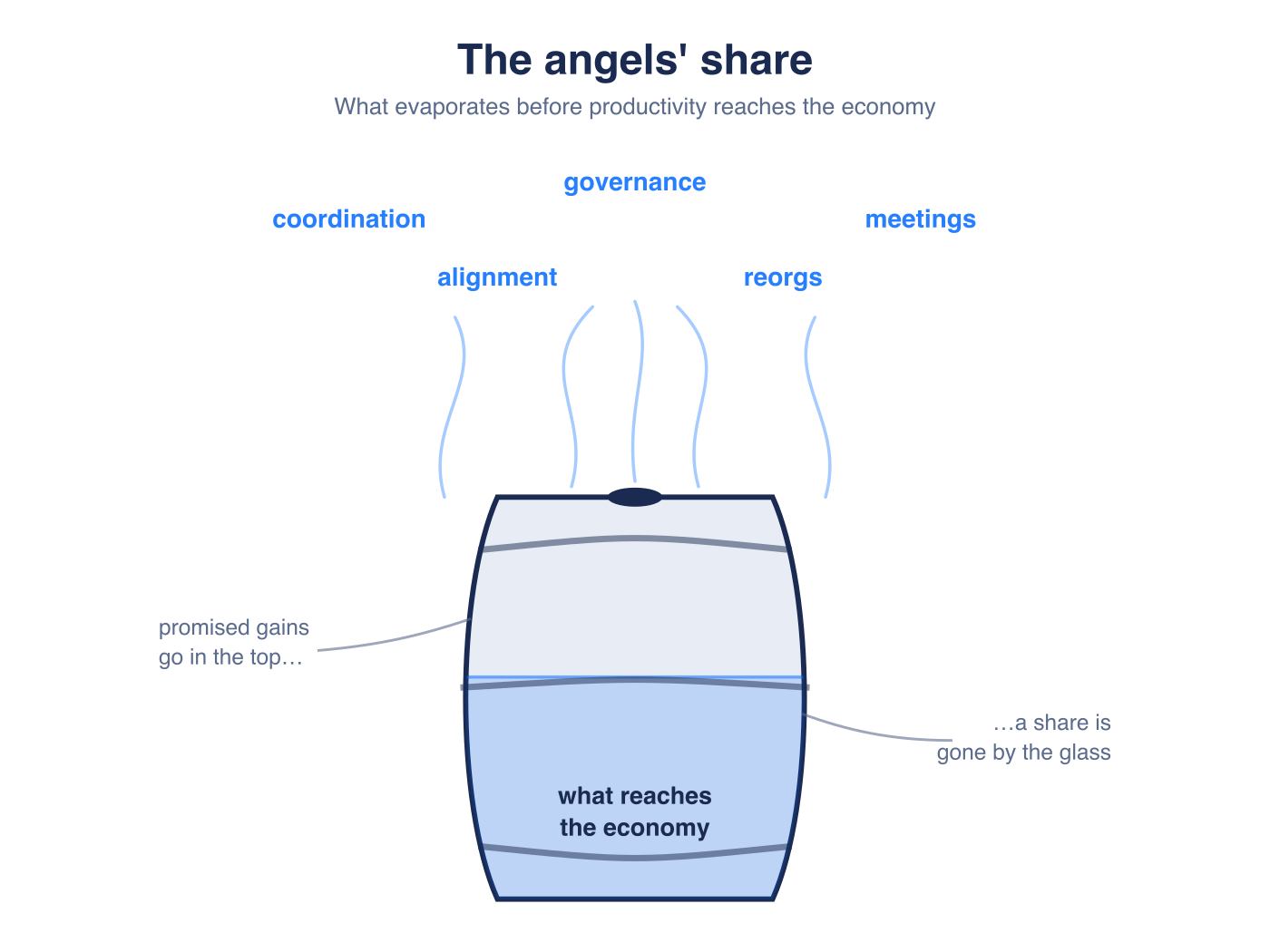
And here’s the part the distillery gets to avoid. Their angels are disciplined. It’s 2% a year, near enough, every year, a constant they can plan around. Ours compound. Every new capability we add is one more thing to coordinate with all the others, so the coordination cost doesn’t hold steady, it grows, and it grows faster than the thing it’s coordinating. The share the angels take gets bigger every year. We’ve quietly accepted, the way the distiller accepts the 2%, that most of what we make just breathes away. We stopped questioning it a long time ago.
The diagnosis
The dominant cost in a modern organisation stopped being computation decades ago. It fell off a cliff and it’s still falling, cheaper every single year. But that was never where the money was going. The expensive thing, the thing eating the gains, is coordination, and coordination didn’t get cheaper. It got dearer, for the exact reason the compute got cheaper: we used the cheap compute to build more, and everything we built had to be coordinated by people who cost more every year and don’t run on Moore’s law.
We spent fifty years optimising the input that was already cheap. Faster chips. Faster networks. Then tools to make an individual person type a bit faster, review a bit faster, ship a bit faster. All of it aimed at the spirit going into the cask, and none of it aimed at the hole in the roof. You can make the world’s fastest developer and it changes nothing about the twenty-five-person standup, because that standup was never a typing-speed problem. It’s a coordination problem, and we have never once pointed the technology at it. Myself included. Near enough everything I ever helped ship made somebody faster and left the standup exactly the size it was.
That’s why the abundance never arrived. We got very, very good at filling the cask, and we let the angels take a bigger cut every year, and we called the leftover “productivity growth” and wondered aloud why it kept disappointing.
The bottleneck was never the machines
None of this is the machines’ fault. Read it as me going after the technology and you’ve got me backwards. The kit is extraordinary. Every layer of it earned its place. A business exists to create value and every one of these capabilities helped it do that. The problem isn’t the technology. The problem is that we aimed all of it at the cheap half of the ledger and left the expensive half untouched for fifty years.
The bottleneck was never compute. It hasn’t been for most of my career. It’s the human cost of holding a complex organisation together, and every productivity tool that just makes one person faster is polishing the spirit while the roof leaks. It never touches the angels’ share. It can’t. It’s aimed at the wrong thing.
For the whole history of the problem, reaching that share was impossible, because coordination was irreducibly human and humans don’t scale. The only way to do more of it was to hire more people, and every one of them added something new to coordinate. That’s the trap, and we’ve been in it my whole career. For the first time, I don’t think we’re stuck in it any more. Something can finally get up into the warehouse air and claw the share back.
Which sounds like unambiguously good news, right up until you remember what the share is made of.
It was never vapour. The angels’ share is coordination, and coordination is people. The programme manager. The team whose entire job is the seam between two other teams. The layer of management that exists to keep the layer beneath it aligned. In a warehouse nobody mourns the two percent, because the angels aren’t real and the only one out of pocket is the accountant. In an economy the angels are real. They have mortgages.
So play it out. Suppose we actually do it. Suppose the coordination that eats a third of every organisation gets done overnight by a machine, and the days of inebriated angels are finally behind us. The abundance Keynes promised turns up, fifty years late. And the bar tab lands. Last orders for everyone who made up the share.
I don’t know what happens to them. Neither, for all the noise, does anyone selling the machine. That’s where this goes next.